Showing posts with label Folk Speech. Show all posts

Tuesday, July 30, 2013

More Weather Lore


The Kelley School
Blue Ridge Parkway
MP 149


A great nut year is a great bastard year
It is said that when there is a bumper crop of walnuts in a given year,
 that the following year will have a larger number of bastards.
So, just to be safe, if you see lots of walnuts hanging in a tree,
you might want to lock up your daughters!

When April blows his horn, 'tis good for hay and corn
(horn = thunder)

A wet May brings a good load of hay
(Plenty of sun in June)

If leaves wither on their branches in late autumn, 
instead of beginning to fall in October as normal,
an extra cold winter is due.

A large number of foggy days in October indicates a hard winter

A cold November signifies a mild winter

Black-eyed Susans
Rudbeckia hirta


A green Christmas (like a warm May) means a fat churchyard
This seems to be based on fact.

Dew in the night, the day will be bright
(If you ever get up on a summer morning and the lawn is dry, it is an ominous sign!)

A hot May makes a fat churchyard
(It does seem that a warm May makes extra work for florists, undertakers and crematorium attendants.)

 Copyright 2013--All Rights Reserved--The Wheel & Distaff by Kimberly Burnette-Dean

Wednesday, October 31, 2012

Folk Speech


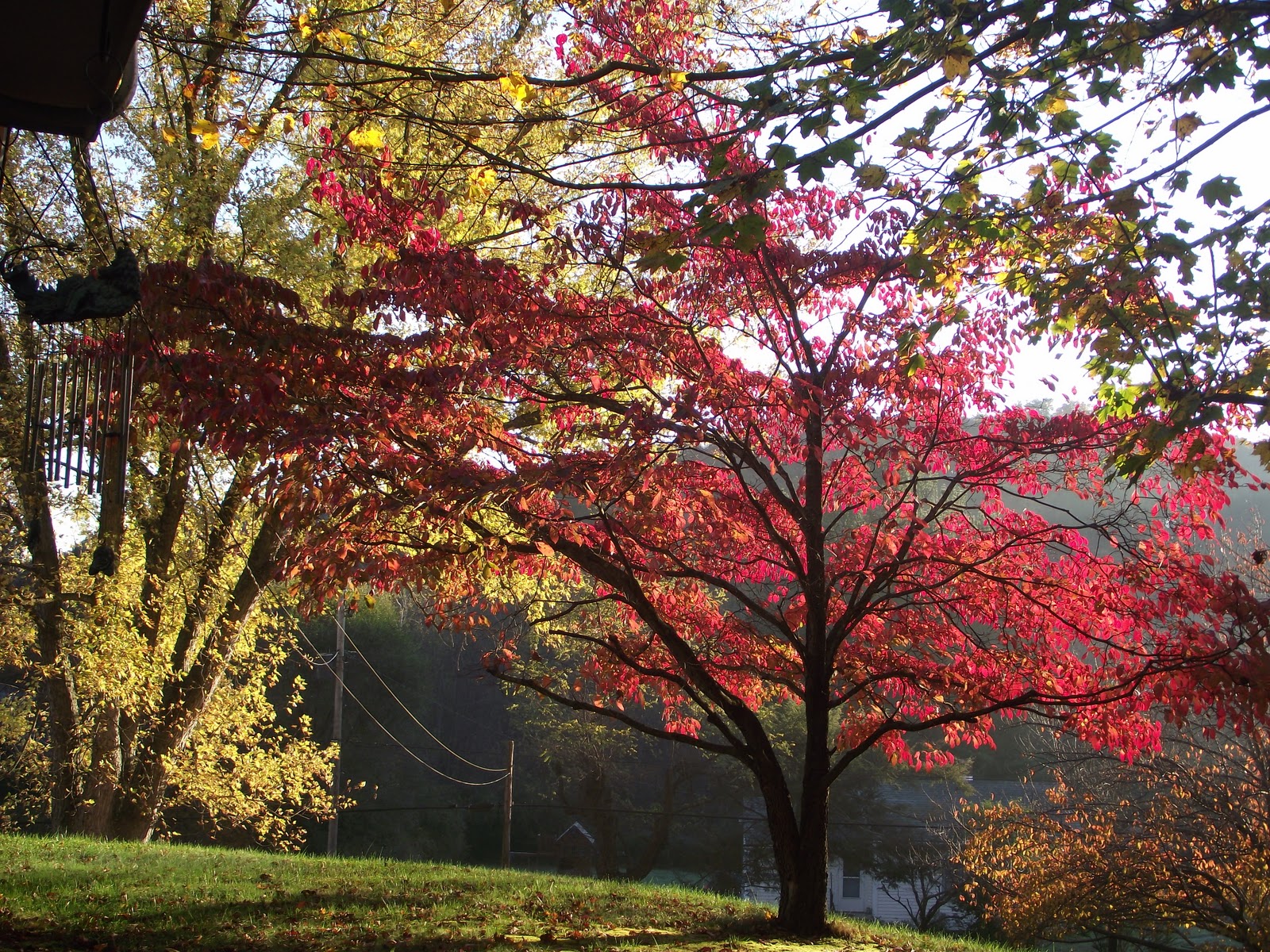
Halloween Sunrise 2012
Photo by Kimberly Burnette-Dean


hankering--to really want something.  "I have a powerful hankerin' for some fried apple pies."

meathouse--the small building where the supply of meat is smoked or salted and kept for use.

queerly--Strange or odd.  "All of a suddenly I'm feeling a mite queerly."

tolerably--moderately.  "How are you feeling today?"  "I'm feeling tolerably well."

hard put--almost impossible.  "I would be mighty hard put to get all of that wood chopped before supper time."

retch--reach. "Retch me that plate of bread."

punk--wood that is decayed and makes good tinder for starting fires. "Give me some of that punk wood so that I can build a fire."

heave--to make an effort to vomit. "That possum stew just about made me heave."

querl--to twirl, turn, or wind around. "Querl up that rope before it gets all knotted up."

Have you ever heard any of these?

Monday, September 17, 2012

Weather Lore


The number of fogs in August determines the number of snows in the upcoming winter.  If they are just light fogs that burns off quickly, then there will be light snows. Heavy fogs?  HEAVY SNOW!

When you hear the first katydid, it will frost in sixty days.

If berries and nuts are plentiful, there is a hard winter coming.

The more black than brown on a wooly worm or the wider the black stripe, the worse the winter.

A warm November indicates a bad winter.

Big wet snowflakes indicate a short snow storm.  If the snowflakes are small and powdery, you better be ready to start shoveling!

The day of the month on which the first snow falls will tell you how many storms you will have in the upcoming winter.  For instance, if the first snow happens on December 3, then there will be 3 storms.

Real spring will not occur until it snows on some daffodils in bloom. That snow is called a daffy snow.

If you hear thunder in winter it means that colder weather is coming.

If it rains while the sun is shining, it means that the devil is beating his wife.

When you see cows huddling up in the pasture, you know to expect rain.

Copyright 2012--All Rights Reserved--The Wheel & Distaff by Kimberly Burnette-Dean.

Thursday, June 21, 2012

19th Century Slang


Coon's age: a long time.  "I haven't heard from him in a coon's age!"

Absquatulate (1843):  to take leave, to disappear. "I had a cake cooling in the kitchen and my husband absquatulated with it, leaving me with the crumbs!"

Savage as a Meat Axe (1835): extremely savage. "He was sitting there sharpening his knife looking as savage as a meat axe."

Conniption fit (1833): a fit of hysteria. "She threw a conniption fit when she realized that he had lost his wedding band."

Seed (1825): used instead of saw or seen. "You can say what you want to about him, but I seed him do it!"

Hang up one's fiddle:  to give up.

Hooter (1839): a bit; a tiny amount.  "Politicians don't care a hooter, so long as their own selfish ends are obtained." (I would think that the more commonly used, "hoot" has it roots here.  i.e "She does not give a hoot about anything.")

Man alive (1840):  popular exclamation expressing surprise, shock. "Man alive!  I can't believe that you just smacked that big bull!"

Wrathy (1834): angry.  "Some folks get might wrathy if you pick on them about their looks."

Tuckered out (1853): exhausted. "After weeding the whole garden, she was plumb tuckered out."

Sour on (1862): to get sick of something or someone.  "Listening to her go on and on about her needlework just totally soured me on the thought of even trying it myself."

The only ones that I have never used or heard used are absquatulate and wrathy. Which ones have you used?

Copyright 2012--All Rights Reserved--The Wheel & Distaff by Kimberly Burnette-Dean. 

Saturday, June 16, 2012

Folk Speech


beestlings or beeslings--The first milk that a cow gives after birthing her first calf.  It was believed that pouring this milk over the rump of the cow would make her a good and docile milch cow. (I have never heard this word used, have you?)

slab-sided--having flat sides like slabs, tall & lank.  "You better start feeding that horse better because he sure is slab-sided." (I can remember my dad using this one all of the time.)

draggletailed--Untidy;  bedraggled. "You sure are looking all draggletailed after taking care of those kids all day!"

pissabed--The dandelion flower.  Children are warned not to pull it because it will make them wet the bed at night.

draw-bar--A bar or set of bars in a fence which can be drawn back to allow passage. "I hope that you remembered to secure the draw bars so the horse doesn't get out."  (I had not thought about this word in years, but when I was growing up, I had a horse named Black Beauty.  Yes, I know....I was not very original!  To get to the barn, I had to lower the drawbars to get through the fence to go ride.  Black Beauty had a foal named Midnight and she was VERY talented at rubbing against the drawbars until they fell to the ground, then Midnight would show up at the front porch where we were all sitting. Grandpa had to finally put removable pegs into each bar to keep that horse in the field! That horse would follow my Grandpa around like a dog when he was in the fields too.)

belly-aching--whining and complaining.  "She just needs to stop all of that belly-achin' and be content with her life." (I think that just about everyone in my family used this term!)

monack-- (moonack)--A woodchuck or groundhog.  (I have never heard this word used either!  Have you?)

nubbin--A small or imperfect ear of corn.

 Copyright 2012--All Rights Reserved--The Wheel & Distaff by Kimberly Burnette-Dean.

Thursday, May 24, 2012

Folk Speech

A visitor in my backyard
Are you familiar with these words?

Naught (aught)-- zero.  "If you subtract 3 from 3 you are left with naught." 

Munts--months. "I have not seen him for two munts."

Farting-Spell--A short space of time. "She can make a whole quilt in just a farting-spell. 

Needle-wires--knitting needles

Eow (Yoe or Yowe)--A female sheep

Noggin--A vessel of wood, with iron or brass hoops. Also refers to hair that is cut straight round as if a noggin had been turned over the head to cut by.  (I would guess that is why we sometimes refer to someone's head as as their "noggin.")

Ewst--Past tense. Used; was accustomed. "She ewst to go to that church."

Noration--A rumor; a long, rambling account.  "She put out the noration that there would be a dance there next week."

Ellum--An elm tree

Copyright 2012--All Rights Reserved--The Wheel & Distaff by Kimberly Burnette-Dean.

Sunday, April 29, 2012

A Child By Any Other Name . . .


Most of us have heard children referred to as "kids". I once had a teacher tell me to stop that because "kids" are baby goats!  Young'uns is another fairly common term.  I have also heard "lil' shaver". BUT, have any of you ever heard children referred to as "suck eggs"?  I remember my grandpa telling me that I was just a little suck egg when I was a little girl.  I also remember him referring to other children the same way.
Me back when I was just a lil' suck egg
What names have you heard for children?  Have you ever heard "suck egg"?

Copyright 2012--All Rights Reserved--The Wheel & Distaff by Kimberly Burnette-Dean. 

Saturday, April 7, 2012

Folk Speech

Photo taken on I-26 Tennessee/North Carolina border


Do you use any of these words or have you heard them used before?

Dirt Dobber--noun--Mud Wasp

Fire Dogs--noun--Andirons

Nabs--noun--Cheese crackers filled with peanut butter

No account--adj--worthless.   "He is no account."

Partial--adj--To be partial to anything means to like it.  "I am very partial to rhubarb pie."

Peart--adj--lively, feeling well, in good spirits.  "You are looking acting peart today!"

Peaked--adj--looking sickly, pale.  Pronounce it with two syllables "Peak ed".  "John was looking a mite peaked last night."

Wool, Wooling--adj--rubbing, rumpling hair or tousling .  "Stop wooling that kitten to death!"

Copyright 2012--All Rights Reserved--The Wheel & Distaff by Kimberly Burnette-Dean. 

Saturday, February 25, 2012

Virginia Names and the Way We Pronounce Them

View from Rocky Knob
Photo by Kimberly Burnette-Dean


I have always found it so interesting when folks who are not from this area of Virginia "mispronounce" certain words.  For instance, most folks would pronounce "Buena Vista" the way that you would say it in Spanish.  Of course, if you live in this area, you say "Bue-na Vis-ta."  "Staunton" is pronounced "Stant-un." "Wytheville" is pronounced "With-ville." I recently heard "Raleigh" pronounced "Rally" by two of my co-workers.  I have always heard it pronounced "Ra-lee." Of course, there are many others.

What are some that you have heard of?


The following is taken from: Word Book of Virginia Folk Speech by Bennett Wood Green, 1899.

SPELT                                                CALLED

Botetourt                                              Bot' etot
Fontaine                                               Foun' tain, Fon' tin
Gloucester                                           Glaw' ster
Goode                                                 Gude
Gravely                                                Grav' elly
Lawrence                                             Lar' ance
Maury                                                   Mur' ry
Patrick                                                  Part' rick
Napier                                                  Nap' per
Sclater                                                 Slaugh' ter, Slater
Sinclair                                                 Sink' ler
Taliaferro                                              Tol' iver
Urquhart                                               Urk' art
Woodward                                            Wood' ard
Wyatt                                                    Wait
Yates                                                    Yeates
Yeardley                                               Yard' ly       

Copyright 2012--All Rights Reserved--The Wheel & Distaff by Kimberly Burnette-Dean. 

Sunday, January 15, 2012

Folk Speech


gallowses--another word for suspenders.   "If you can't keep your pants up, maybe you need a pair of gallowses."  My grandparents used this word quite a bit.

gaumed up--to make a mess.  "She obviously does not know how to sew.  I have never seen such a gaumed up dress in my life."

gettin' above yer raisin'--acting stuck up or like you are rich and famous when you are not. "Just look at Suzie with that fancy hairdo and all of that jewelry.  If you ask me that girl is gettin above her raisin'!"

plumb--completely or all out.  "I scared Grandma plumb to death when I jumped from behind the door!"

got a face that would stop an 8 day clock--very ugly.  "That girl's face could stop an 8 day clock!"

gum'd it--chew it.  "Granny had to gum that chicken since she ain't got no teeth!"

gussied--getting dressed up nicely.   "What are you gettin' all gussied up for?  Are you going to a party?"

foller yer own lights--do what you know is right.  "You better stop doing what all of your friends are doing and foller yer own lights!"

fit as a fiddle--fine.  "I think I will go climb that mountain today because I am feelin' just as fit as a fiddle!"

farn--foreign or unusual.  "That dragonfruit is farn to this country. I'm not sure where it comes from."

Sunday, November 6, 2011

Virginia/Mountain Speech #4

Dogwood

aggravatinists--"That rooster is the aggravatinists thing when he starts crowing at 4 am every morning!"  (most aggravating)

aspell--"I am going to sit with you aspell and do a bit of knitting." (awhile)

yander--"Why, those folks just live right over yander!"  My grandpa used to say this all of the time and I always wanted to be just like Grandpa, so of course, I started repeating it.  My mom would get so mad and tell me to STOP saying that because "yander" is not even a word!  (yonder)

backards--"Did you get dressed in the dark this morning?  You have your shirt on backards!" (backwards)

bub--"The light bub on the porch has burned out again."  (bulb)

chimley--"Santa always brings me great presents when he comes down the chimley."  I still say "chimley" rather than "chimney"!

cut on the light--"It sure is dark in here, please cut on the light."  I still use this one all of the time. (turn on the light)

trim a pencil--"The lead in my pencil just broke.  I am going to look for a pencil trimmer."  I never realized that this was the least bit strange until a co-worker looked at me like I was nuts! (pencil sharpener)

druthers--"If I had my druthers, I would always eat a piece of pie before I would eat mustard greens!"  (rather)

dreen--"If you would dreen the water out of those pinto beans, we could go ahead and start cooking them."  (drain)

eat a bait--"He came over for dinner and laws, he did eat a bait of food!"  (eat large quantities)

getting your dander up--"You don't have to get your dander up, I'll make more cookies." (upset)

                                 ***********************

If I had my druthers, I would stay home from work tomorrow!

Thursday, October 13, 2011

Virginia Folk Speech #3

Photo taken on Mill Mountain, Roanoke, Virginia 2009


Ailing--To feel pain; be unwell.  "She is ailing today."  (When I was growing up, there was a woman who lived near us and she was constantly complaining about her health. So anytime her name was mentioned, the first response was usually, "So, what's ailin' her today?")

Jaw--To talk or gossip.  (Many times I heard my grandpa tell grandma to "stop her jawing" when she was talking with friends on the phone!)

Ailments--Disorders; disease.  "She is full of ailments."

Jimber-jawed--Having a projecting lower jaw.

Amind--Aminded--Disposed; inclined to.  "I have amind to buy that new spinning wheel."  "Any person aminded to buy that ugly heifer must be half crazy."

This, that and tother--This, that, and the other.  "What have you been doing all day?"  "Oh, just this, that and tother."  (My grandmother used to say this all of the time so of course, I picked it right up from her much to my mother's dismay!)

Ammon--Almond.  (We always called them ammons.)

Bark--To knock the skin off.  "I just barked my shin against that door."

Muley Cow--A cow without horns.

Knit--To grow together, as the ends of a broken bone.  "The bones of his leg didn't knit straight."

Jowl--The lower jaw, usually refers to a hog jowl but also a human jaw.  "I am going to smack you right in the jowl if you don't stop backtalking your mother."

Tom-walkers--Stilts on which a child walks.  Usually made of saplings with a short limb being used for the footrest.

We also just LOVE to string together a whole bunch of prepositions!   "You come on out from down in under that table!"  Every time that I hear myself or my husband do this, it just makes me smile.  It really does place a nice emphasis on what you are trying to say! 


Wednesday, September 28, 2011

Virginia Folk Speech #2


We love to put "All" in front of words just like we like to add an "A" to some!

All-about (adv)--Scattered; in disorder.  "I found those toys scattered all-about the house."
All-alone (adv)--Quite alone.  "He is now living all-alone since his wife died."
All-along (adv)--Throughout; continually; from the beginning.  "Well, I have known that she was a spoiled brat all-along."
All-but (adv)--Almost.  "Have a little patience!  We are all-but there."
All-fours (noun)--To go on the hands and feet like an animal.  "Look at those kids running around like horses on all-fours.
All-over (adv)--In every part; everywhere; over the whole body.  "He is his father all-over!"  (He is exactly like his father.)
All sorts of (noun)--Expert; excellent; expert in many ways.  "She is all sorts of a good cook."
All-to (adv)--Excessively; out and out.  "That girl out played that boy all-to pieces."

Saturday, September 17, 2011

Virginia Folk Speech #1

Blue Ridge Parkway near Fisher's Peak


I have been fascinated with the English language for years and especially the variations in regional dialects.  Sadly, since we are all exposed to so much media these days, regional differences are slowly fading away.   With this series of posts, I hope to preserve some of those differences.

Some of the words and sayings that I will be posting are from The Word Book of Virginia Folk Speech, 1899. Some will be sayings and words that I recall hearing and using.


"A"--Used before many words and it has the broad sound to it:
"Yes, you told me to it, so I'm a-doing it right now!"
"Don't get your knickers in such a twist, I'm a-coming right now!"
"I know that I have been putting it off, but I'm a-going to do it tomorrow."
"I'm a-running a tad late, but I will be there soon."
"The house is a-fire."

Abide  (verb)--endure, suffer.  "I just can't abide liver and onions."

Able (adj)--healthy.  "He is an able man, so he should be out working to support his family."

About (adv)--to be astir, be on the move; be attending to one's usual duties.  "It sure is good to be about after being so sick with pneumonia."

Above-board (adv)--Open, unconcealed.  "I don't mind doing business with him because he is always so above-board in his dealings."

Ache (verb)--to express intense desire, rather than pain.   "I am aching to move back to Meadows of Dan."

Agg (verb)--To raise a quarrel. I have also saw this spelled "egging".  "That fight broke out because he was just agging them on."

Aggravation (noun)--Provocation, irritation.  "Kimberly was a great aggravation to her mother when she was growing up."